
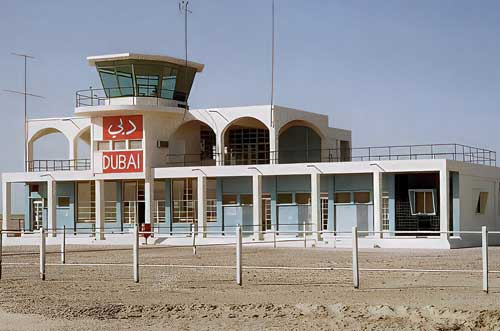
Original Dubai Airport
A few years ago, I went looking on the Internet for information about Dubai as it used to be.
I found this article by Peter Liver about time he spent in 1970s Dubai training with BOAC.
Peter not only describes working at the original Dubai Airport but details aspects of Dubai as it used to be in 1970s.
I finally decided it was time to add Peter's intriguing story to DAIUTB!
I have made some minor changes.
Otherwise all the words are Peter's.
Len Chapman 1/12/2026
As a new BOAC overseas trainee, an early test was geography.
A smart light blue ‘trainaid’ was provided with stations marked by their three letter codes and a city decode by region down the side.
The test sheet was a blank world map accompanied by a sharp pencil with a request to place a dot on the map exactly where each of a selection of stations was located.
Hmmm. Lusaka? In East Japan? Er, no, that would be Osaka. Dubai? Where?
This unfamiliarity with what was then known as the Trucial States and Oman was acknowledged a week later with a ‘plane ticket for a first training posting to DXB.
There was irony in this as I had read geography at Durham University.
It was my department that had been asked to carry out a soil survey by the then Trucial States Development Council as part of wider work to understand the agricultural potential of the area.
I should have paid less attention to glaciation in Norway and noted my professor’s experience of the Middle East!
That October, a sleek BOAC VC10 took two of us to Dubai.
First glance from the air showed nothing but desert and a small town clustered around a large creek.
We soon settled into one of Dubai’s two international hotels, the Al Bustan (The Garden) a short stretch of scorching sand from the fledgling airport.
The VC10 Crew stayed in the other slightly grander hotel downtown, the Carlton.
For our first shift, we put on our new BOAC uniforms with crisp white military style short sleeved shirt with blue and gold epaulettes resembling a midshipman’s tabs.
The BOAC Airport Manager was friendly but a little unsure what to do with such barely trained individuals!
Check-in seemed a good place to start. We were assigned to DNATA, the handling agent, and the tender care of their Indian Shift Supervisor. He was a wise old bird, especially in the mysteries of excess baggage charges and how they were avoided.
He soon had us peering behind the check-in hall’s columns for stashed bags the scales had not seen.
Meeting the incoming aircraft was a hats on, stand smartly, moment the formal effect of which was somewhat marred by the Loaders’ local custom of holding your hand - out of cordiality rather than misplaced affection!
Once a week we handled the Gulf Aviation flight to London via Bahrain.
This was operated by a BOAC VC10 ‘transformed’ into a GF service by us placing a large sticker on the forward sides of the aircraft saying ‘GF001’ then loading another sticker for the return flight ‘GF002’. Simple!
The Cargo Shed was another revelation to a Trainee.
Leather goods from India, mangoes from Pakistan and from London, Zurich and Geneva - gold and silver ingots up to 5 kgs.
The new airport had helped boost the gold and silver trade with India. Local merchants attracted by the prices in Europe shipped it into Dubai for conversion into tola bars (11.3 gms), then on to the sub-continent by Dhow.
In India, demand for gold ornaments was strong as were the restrictions on the private import of gold.
The tola was an ancient Vedic measure of mass that British India had used as a standard. Following metrication its use had survived in the gold trade.
The ten tola bar was the most popular being quite portable and, one suspects, easier to conceal.
Our aircraft flew in one night with a pallet full of silver, all carefully netted and lashed down.
We had yet to do the course ‘Lashing and Binding 1’ and could scarcely imagine the joys of ‘Lashing and Binding 2’.
There was no security except our little lockable cage in the shed.
That was until a red open Land Rover turned up, driven by a young Englishman from the British Bank of the Middle East plus a Bedouin with an old Lee Enfield .303 rifle in the back of the Land Rover.
We loaded a fortune in silver onto this Land Rover.
The Bedouin climbed on top of the loaded silver and the vehicle drove away, very low on its springs.
It was bound eventually for Dubai Creek and its dhows to be ‘re-exported’ to India.
NOTE: Silver was usually exported from India while Gold was exported legally from Dubai to India but imported illegally into India i.e. smuggled! Peter may nave been mistaken in his description.The friendly Airport Manager offered us the occasional use of the station's VW Beetle, but I needed to obtain a Dubai driving licence to use the VW.
I have my Dubai Driving Licence still, with its youthful face staring out of the past at me together wearing that crisp white shirt and enamel BOAC name badge.
To get the paperwork done, however, one had to go to the main police station then get the Superintendent to sign and stamp everything.
When I entered his office there were at least thirty people present as if he was holding a form of ‘Majlis’.
I took a vacant seat at the back where a very cultivated young man in thobe and shemagh talked to me about London.
He asked "Did I often go to the Savoy?" "Surely I had met his brother?""
Eventually he decided it must be my turn. He rose gracefully and the room fell silent. He took me through the throng to the Superintendent’s desk, who looked me over suspiciously and, without a word, stamped my licence.
I thanked my companion and retreated. I wonder to this day just who he was.
At that time the town, Bur Dubai, was small enough to walk around in an hour or two. The gold souk was quite modest and dusty then but full of life and enterprising merchants.
One could buy a wide range of gold and silver jewellery as well as more domestic items such as huge brass trays for serving mutton and rice and long-spouted traditional coffee pots.
Dubai Creek at this point was lined with berths for sea-going dhows, its wharves piled with boxes and bales.
The Seamen were very affable and would invite you to look around.
If you peered down a hatch you could glimpse a gleaming new Perkins marine diesel engine that would no doubt have given a turn of speed sufficient to outrun an Indian Customs Cutter!
Friday was sometimes a day off.
One week I was asked if I would play rugby for the nascent Dubai Rugby Club and to turn up at this particular apartment.
When I did, I found it full of young men, very little furniture and two huge refrigerators full of beer. I don’t recall ever getting to the sand pitch and barely remember some jolly soul putting me in a taxi back to the hotel.
Amazingly, on the strength of this ‘performance’ I was selected to play against Bahrain the following week.
This colourful posting came to an end all too soon.
It was time to climb aboard the VC10 to return to November in London, clutching two coffee pots and a letter instructing me to report to Cranebank Training Centre for 'Operations 2'.
Lots of meteorology and the mysteries of the intertropical convergence zone followed.
‘Lashing and Binding 1’ would have to wait.
Dubai's original compacted-sand runway opened in 1960.
Runway was upgraded to an asphalt runway in 1963.
Runway was extended in 1967 to handle airliners such as the Boeing 707 and BOAC Vickers VC10.
So Peter Liver would have been working out of the original 1960s Dubai Airport Terminal Building while handling the latest Jet Airliner in the Vickers VC10.