
George Chapman was 25 years of age when he arrived in Dubai in 1951.
He spent the next 70+ years living and working in Dubai.
During that time George:
- Managed and developed Gray Mackenzie and Company.
- Became Marine Advisor to Sheikh Rashid bin Saeed Al Maktoum, Dubai's Ruler
- Set up and Chaired an independent company to operate and manage newly built Port Rashid
- Established Dubai English Speaking School
- Established Dubai Seafarers' Centre
- Awarded MBE and OBE by UK Government
George Chapman OBE died in Dubai, August 2023 aged 98 years.
And so in 1951, I was back on a train again on my way London where I boarded a British Overseas Airways Company (BOAC - forerunner to British Airways) flight for the Gulf.
We landed in Palestine because of engine failure and were stuck there for eight days.
That gave me my first taste of the Middle East...
I was immediately caught up in its spell.
The plane was eventually airborne again heading for Bahrain which was an important landing stage at the time.
I then came down to Dubai by sea. I could have taken the Gulf Aviation flight from Bahrain to Sharjah - Gulf Aviation was the forerunner to Gulf Air and Sharjah acted as the air gateway for Dubai and the rest of the Trucial Coast Sheikdoms - but the journey by sea was infinitely more interesting for me and it gave me time to collect my thoughts and focus in on my new career.
The next two months were spent familiarising myself with the company's operations, travelling around the region getting to know the people in each of Gray Mackenzie's offices and learning their processes.
George often spoke of writing a book about his unique life in Dubai.
Sadly, that never happened.
What follows is a collection of George's conversational comments about life in Dubai as he experienced it in 1951 and later.
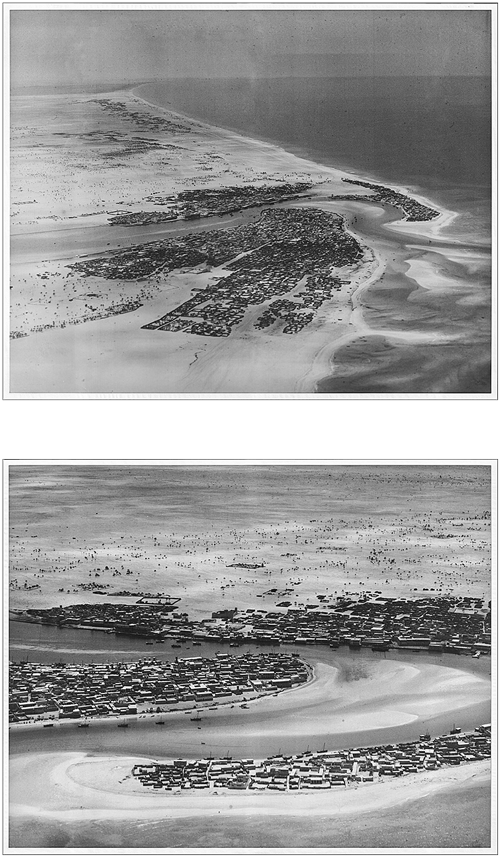
Dubai was a small fishing town of mud buildings and reed huts clustered around a large fort. That fort was constructed of coral and mud and located on the western side of the tidal inlet known as Khor Dubai or Dubai Creek.
Kuwait and Bahrain were then the main trading ports in the Arabian Coast.
Dubai's Ruler persuaded Persian Traders to settle in Dubai. Their expertise made Dubai into the main trading centre for Oman Peninsula hinterland.
Trading grew slowly during the first half of the nineteenth century with southern Iran and Baluchistan as the major customers. Trading commodities were grain, tea and rice.
Large oyster shells, collected from the pearling banks, were also in demand. These were sent to Germany to make buttons and buckles.
Dubai was once an important centre for pearls gathered from the shoals off Qatar and Trucial Coasts.
At end of the Pearling Season, more than 100 boats, each manned by 30 or 40 chanting slaves pulling on long sweeps, returned to Dubai in flotillas bringing their valuable cargo.
During the hot and humid months of May to September, Pearl Divers remained camped in their boats on the pearling banks. They lived on a meagre ration of food and water.
Pearl diving was a hazardous occupation. Respiratory illness was high with sickness and disease spreading rapidly through these crowded dhows.
In 1940s, Gray Mackenzie & Co. were appointed landing contractors to the Government.
Three small steel barges and a motor launch were stationed in Dubai to handle the growing import cargoes. Offloaded cargoes had previously been transported by sailing boats called tishallahs.
Several thousand tons of dried fish were exported to Europe each year to be used for fertiliser and cattle food.
In 1951 George Chapman was appointed Wakil (Agent) for Gray Mackenzie & Co.
Dubai, with a population of about 17,000, was the principal coastal township but with few facilities.
Fish, rice and bread, with an occasional emaciated chicken or goat formed the staple diet with limited tinned food sold by two small shops. Fresh fruit and vegetables were in short supply. White radish, a type of cress, pomegranate from Oman and bananas in season from Bhatinah Coast were available.
Kerosene powered refrigerators were the only means of refrigerating food. They were not cheap! They had to be inverted for 24 hours every few months to restore the cooling system!
Roads were tracks that swiftly became quagmires in heavy rain
First stretch of a one-kilometre tarmac road was not laid until 1960. That road ran between Dubai Creek and the new Zabeel Palace.
There were a few Land Rovers and vintage saloon cars. Sheikh Shakbut of Abu Dhabi owned a Model T Ford which miraculously made the journey between Abu Dhabi and Dubai. That entailed a 50 miles drive along the beach to Khor Ghanada before striking inland along a ten-mile stretch of treacherous Sabkha to Abu Dhabi Island.
People only travelled if they had to because should you get stuck. There were not many Bedouin villages along the way that could render help.
On one occasion, George related he became stuck in his Land Rover for 24 hours in the salt marshes on the way to Abu Dhabi. “It was like sitting on top of a custard pie”, he said. George regretted changing his Land Rover for a modern saloon many years later.
“Bumping up and down every sand dune in the Land Rover kept me fit physically,” George said, “I got all the exercise I needed. Now I have to run a couple of miles a day along the beach to keep fit.”
Travelling by car back then, meant carry everything - water, food, tent, spade, ropes and a piece of steel sheet known as chinko to help dig the car out of the sand. A hand spray and a tin of ‘impish’ for the flies were essentials.
On the East Coast, during the early months of the year, flies were numerous, attracted by dried fish used for fertilising date palm gardens. It was impossible to expose any food during daylight hours. Everyone ate before sunrise or after sunset.
Construction of roads has been one of the greatest contributions to development. A drive to Al Ain took eight hours provided one got over the Ramlet sands on the first attempt. Khorfakkan was about the same duration via Aswad in Oman as there were no passable routes through the Hajar Mountains. Muscat was nearly 24 hours away.
Only way to cross Dubai Creek was by rowing boat or Abra (Arabic for crossing to the other side).
“One became accustomed to their erratic movements in time but there were many mishaps,” George recalled.
Medical facilities were very limited.
Doctor Col. D. G. McCaully's ‘hospital’ was a mud room on the side of Dubai Creek measuring 14 by 12 by 6 feet high.
An unforgettable sight, recalled Chapman, was that of Desmond’s entire 6 feet 2 inches bulk descending the steps of the Beyt Wakil (Agent’s House) by moonlight. He walked straight passed the Abra and disappeared under the somewhat grubby waters of Dubai Creek. An extensive salvage operation the following morning recovered spectacles and his personal possessions including his stethoscope!
The name Dubai derives from the Arabic word for young locusts not yet able to fly, and in this form, denotes a soft tract of desert where locusts lay their eggs.
George mused that the adjective “soft” belies the turbid past and exciting future of this once relatively unknown part of the world.
Dubai developed a hundred years in ten, emerging as an exciting, strategic and prominent area in modern-day world affairs.
Dubai had only two or three electricity generating sets at that time.
Gray Mackenzie had one 3-kilowatt machine for lights and fans in the office and home.
At night, Dubai would ‘black out’ after supper. Guards manned seven watch towers strategically built around the town for basic security. Guards called to each other in a distinctive way but within an hour or so, sleep took over.
One of the ‘childish’ amusements when Wakil had a dinner guest was, after dinner, Wakil and Guests went to the roof and imitated the Guard’s call. Guards were awake in seconds, resuming their duty until sleep came again.
Another nocturnal custom during Ramadan was the one-legged drummer parading through Bur Dubai's alleyways, arousing sleepers to start preparing the suhoor – the early morning meal.
The Ruler’s Guards, or Followers, were the only instruments of law when the need arose.
Trucial Oman Levies, stationed in Sharjah, were raised in 1951 to deal with the disputes between the Emirates over boundaries, wells and date palms. Later known as The Trucial Oman Scouts.
In 1955 TOS participated in eviction of Saudi Arabian army that had occupied Buraimi Oasis four years earlier.
Despite the absence of crime, a Police Force was formed in 1958.
Infrastructure was limited but some basic facilities were in position.
A small office of the British Postal Service from Bahrain handled mail.
A branch of Bank of Iran and the Middle East (B.B.M.E.) established in Deira in late 1940’s.
At Sharjah, International Aeradio managed air traffic for UK's Royal Air Force and maintained a telegraphic link with the outside world.
Other British residents in Sharjah were members of the DL&S (Desert Locust Survey) – controlling swarms of locusts which were prevalent at that time.
Gray Mackenzie's generator powered the only navigational aid to vessels in the form of a 200W bulb mounted on the office flagstaff. It was the Night Watchman’s job to start the generator early morning if a ship was expected. Admiralty charts recorded this light to be ‘unreliable’ which was just as well as the watchman often overslept.
Nevertheless, Captain of M.V. ‘Dara’ once reported citing the light from 13.5 miles away. Although the proud agent tended the light and replaced hard-to-come-by bulbs. the light was lost amongst the growing number of street lamps and neon signs flooding the town with the advent of mains electricity in early 1960’s.
About the same time, the telephone system was installed in the town; fresh water distribution system supplied from wells in Awir began and the first bitumen surfaced roads appeared.
Other developments followed due to the determination of Sheikh Rashid to bring Dubai into the twentieth century. Results surprised him, as he remarked on more than one occasion.
British India Steam Navigation Company’s mail steamers sailed between Bombay and Basra. Their fortnightly calls to Dubai were a highlight. These ships were the only means of travel until Gulf Aviation, founded by a Freddie Bosworth in Bahrain, inaugurated a weekly air service in 1951 to the Royal Air Force staging post in Sharjah.
When the Office Roof Look Out reported a vessel’s smoke on the horizon, two or three small launches, dangerously over-loaded with labour passengers and visitors, awaited the ship anchoring offshore. Then they ‘stormed’ aboard to commence discharge of cargo, meet relatives, steal fresh water or generally conduct private trade with passengers and crew.
On 7 April 1961 , a sudden storm caused mv Dara to leave the anchorage and go to sea taking everyone from shoreside with them.
Early the following morning, near Abu Musa Island, there was a violent explosion and fire on board, believed to have been caused by a landmine smuggled on board by a member of the Omani group. This Group – was supported by PFLOAG Movement in rebellion against the Sultan of Muscat. Vessel’s next port of call would have been Muscat.
Over 200 passengers and crew, visitors and labour from Dubai were lost in this disaster.
The logistical problem was coping with over 300 bereaved, wet and shocked men, women and children, arriving onshore by rescue vessels.
Dubai had no building large enough to accommodate this number of people. This can now hardly be imagined in this present land of plenty.
Later in that year and 1962, there were explosions on two other mail steamers, but with less serious consequences plus several small bombs around the town, including Beyt Wakil. A DC3 airliner of India's Kalinga Airlines also disappeared without trace a few minutes before it was due to land at Sharjah.
These incidents were presumably the work of the same dissidents.
Dubai's development during the 1950’s was hampered by silting of Dubai Creek entrance. This restricted movement of tugs and barges impacting coastal trading.
Serious accidents led to loss of life from boats trying to find shelter during the vicious North-Westerly winds (‘Shamals’) which can savage the Gulf during the winter months.
During a storm, a barge loading dried fish broke away from its moorings and became stranded on the beach adjacent to Shindagha where Port Rashid now lies.
It flooded with sea water which, after mixing with 100-tonnes of dried fish, resulted in a "strong Aroma".
The onshore wind blew the "Strong Aroma" into Shindagha and Deira. Many of the Residents left town and made for the desert to escape the "Strong Aroma".
The Wakil was shunned by the public for many days after the event.
Sheikh Rashid was well aware Dubai's future prosperity lay in its trading potential. He raised finance for a modest programme of Dubai Creek improvement.
Completion of Dubai Creek Improvement Works in 1959 was the beginning of a decade Dubai began to change; from a sleepy desert port into a flourishing and modern trading centre, with the population of 60,000 in 1960 growing into about 3.5 million today.
From the insignificant volume of imports landed by wooden boats in the 1950’s, the modern facilities of Dubai have become major transshipment centres for both the Middle East and the Sub-Continent.
There is every reason to hope that Dubai and UAE will sustain this remarkable progress and add to their brief but colourful, history.
George Chapman was born in Falmouth UK.
As a young man he joined the British Army and served in Northern Burma and Arrakan during World War 2.
After WW2, he returned to Falmouth and joined a local Shipping Agency.
Later George successfully applied for a post with Gray Mackenzie and Co.
Gray Mackenzie and Co. were part of The Inchcape Group of Companies
The Inchcape Group then owned a range of companies operating in Hong Kong, Singapore, India, the Pacific, Iran and the Arabian Gulf.
George Chapman was 25 years of age when he was posted to Dubai.